Choosing the Right PTFE Envelope Gasket: Slit, Milled or Diffusion Barrier?
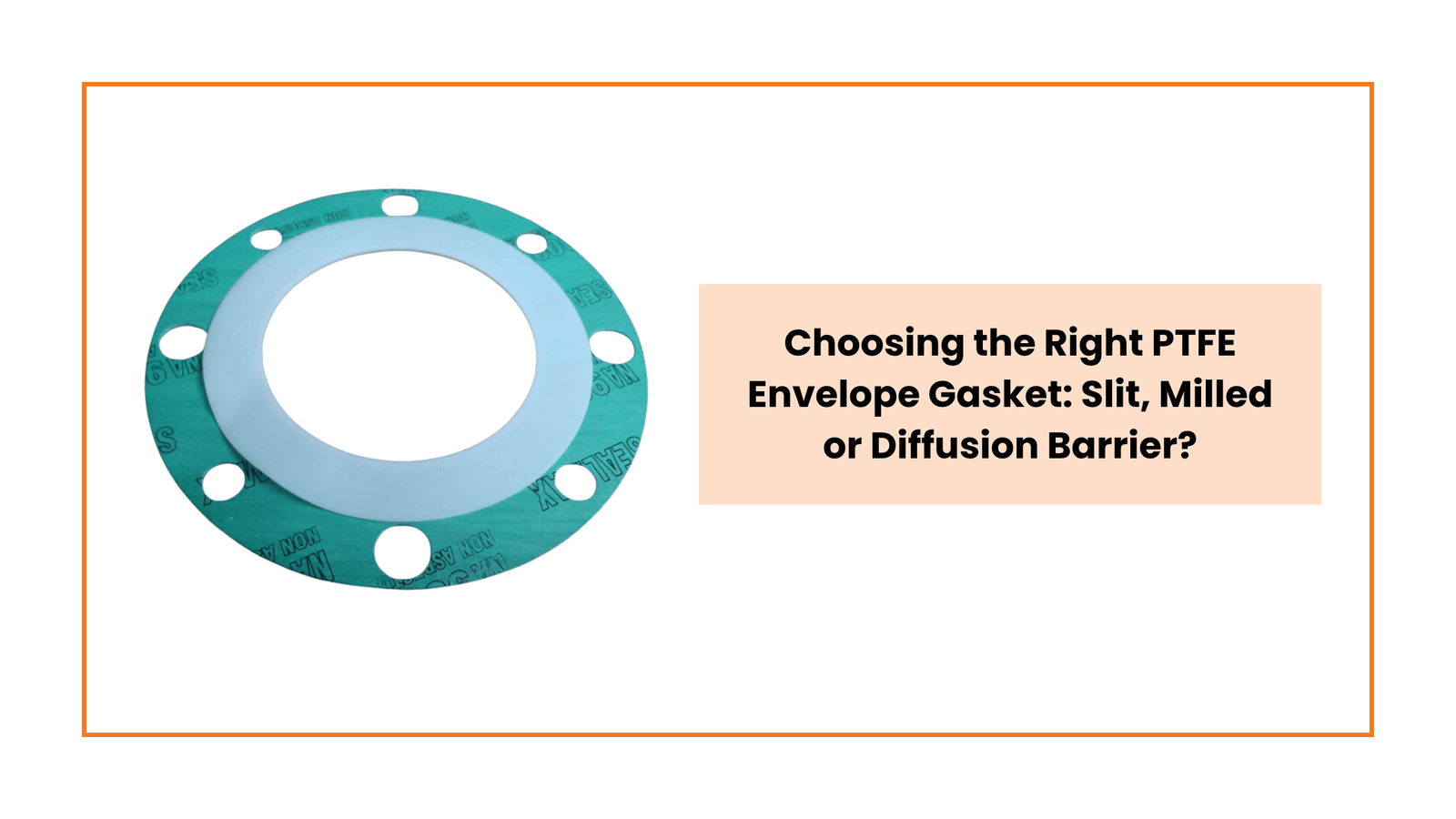
PTFE envelope gaskets have been trusted in chemical processing industries for decades. They combine the exceptional chemical resistance of PTFE with the resilience and recovery of a soft insert material, making them suitable for applications where traditional gasket materials may fail.
However, not all PTFE envelope gaskets are constructed the same way.
A gasket specified simply as “PTFE Envelope” can actually refer to several different designs, each offering different levels of chemical protection and sealing performance.
Understanding the differences between slit type, milled type and diffusion barrier PTFE envelope gaskets can help engineers make a more informed selection and avoid premature gasket failure.
What is a PTFE Envelope Gasket?
A PTFE envelope gasket consists of two components:
- An outer PTFE jacket that comes into contact with the process media.
- A compressible insert that provides recovery and sealing performance.
The insert may be manufactured from:
- Corrugated metal
- Fibre gasket material
- Rubber
- Graphite
This combination allows the gasket to benefit from PTFE’s chemical resistance while retaining the resilience that pure PTFE often lacks.
At Sealmax, PTFE envelope gaskets are available in three primary constructions:
- Sealmax Style 940S – Slit Type
- Sealmax Style 940M – Milled Type
- Sealmax Style 940D – Diffusion Barrier Type
Each design addresses a different sealing challenge.
Sealmax Style 940S: Slit Type PTFE Envelope Gasket
The slit type envelope (also known as “V” type) is the most common and economical PTFE envelope construction.
In this design, the PTFE envelope is formed by folding PTFE around the insert, creating a seam or slit along the outer diameter of the gasket.
Advantages
- Cost-effective solution
- Suitable for general industrial applications
- Good chemical resistance
- Widely available
Typical Applications
- Water treatment
- Utility services
- Mild chemical duties
- General industrial pipelines
Considerations
Because the envelope is formed with a slit, there is a potential pathway through which process media may eventually reach the insert material.
For many non-critical applications, this is not a concern. However, in more aggressive chemical environments, engineers often prefer a fully enclosed envelope design.
Sealmax Style 940M: Mill Type PTFE Envelope Gasket
The mill type envelope (also known as “U” type) is manufactured using a machined PTFE envelope rather than a folded construction. This creates an exact pocket for the core.
The inner dimension of the envelope is machined to sit flush with the pipe or nozzle bore, while the outer dimension sits precisely within the bolt circle. This construction helps ensure complete coverage of the insert while maintaining accurate gasket positioning during installation.
This design provides significantly improved protection for the insert and is often considered the preferred choice for demanding chemical applications.
Advantages
- Fully enclosed insert
- Improved chemical protection
- Reduced risk of media ingress
- Enhanced service life
- Better reliability in aggressive environments
Typical Applications
- Chemical processing plants
- Acid and alkali service
- Pharmaceutical facilities
- Corrosive process media
For many applications, the milled type gasket offers an excellent balance between chemical resistance, reliability and cost.
However, even a fully enclosed PTFE envelope has one inherent limitation.
PTFE is Chemically Resistant, But Not Completely Impermeable
One of the most common misconceptions in sealing technology is that PTFE acts as a perfect barrier.
PTFE offers outstanding resistance to an extremely wide range of chemicals and remains one of the most chemically inert sealing materials available. However, certain gases and low molecular weight chemicals can gradually permeate through PTFE over extended periods.
This process is known as permeation.
Over time, permeation can allow process media to reach the insert despite the absence of any slit or opening in the envelope.
This is particularly relevant in:
- Chlorine service
- Hydrogen service
- Aggressive solvents
- Elevated temperatures
- High-pressure applications
- Long-term operating conditions
To address this challenge, diffusion barrier technology was developed.
Sealmax Style 940D: Diffusion Barrier PTFE Envelope Gasket
Sealmax Style 940D incorporates a diffusion barrier within the PTFE envelope construction to reduce permeation. This added layer helps limit the microscopic pathways through which gases such as hydrogen or chlorine can migrate, providing greater protection for the insert in demanding service.
The result is a sealing solution specifically designed for applications where maximum protection of the insert is required.
Advantages
- Superior resistance to permeation
- Enhanced protection of the insert
- Improved long-term reliability
- Extended service life in aggressive media
- Suitable for critical process applications
Typical Applications
- Chlorine handling systems
- Hydrogen service
- Highly aggressive chemicals
- Solvent service
- Petrochemical plants
- Critical sealing applications
Where process reliability is paramount, diffusion barrier technology provides an additional level of security that conventional PTFE envelope designs cannot offer.
Comparison of PTFE Envelope Gasket Designs
|
Feature |
940S (Slit Type) |
940M (Milled Type) |
940D (Diffusion Barrier) |
|---|---|---|---|
|
Envelope Construction |
Folded PTFE |
Machined PTFE |
Machined PTFE with Diffusion Barrier |
|
Insert Protection |
Good |
Very Good |
Excellent |
|
Resistance to Chemical Ingress |
Moderate |
High |
Very High |
|
Resistance to Permeation |
Moderate |
Moderate |
Excellent |
|
Service Life |
Good |
Very Good |
Excellent |
|
Relative Cost |
Low |
Medium |
High |
Which PTFE Envelope Gasket Should You Choose?
The best gasket is not necessarily the most advanced one. It is the one best suited to the operating conditions.
- For general industrial service, Sealmax Style 940S often provides an economical and effective solution.
- For corrosive chemical applications, Sealmax Style 940M offers improved protection through its fully enclosed construction.
- For highly aggressive media or critical applications where permeation is a concern, Sealmax Style 940D provides the highest level of protection and reliability.
Final Thoughts
While all PTFE envelope gaskets share the excellent chemical resistance that PTFE is known for, the design of the envelope can significantly influence sealing performance, insert protection and service life.
Sealmax Style 940S, 940M and 940D each serve a specific purpose, from cost-effective general service applications to highly demanding chemical duties where permeation resistance is critical.
By understanding the differences between these constructions, engineers can move beyond simply specifying a “PTFE envelope gasket” and instead select a sealing solution that is truly matched to the application’s operating conditions.
Because when it comes to PTFE envelope gaskets, the design is just as important as the material itself.