
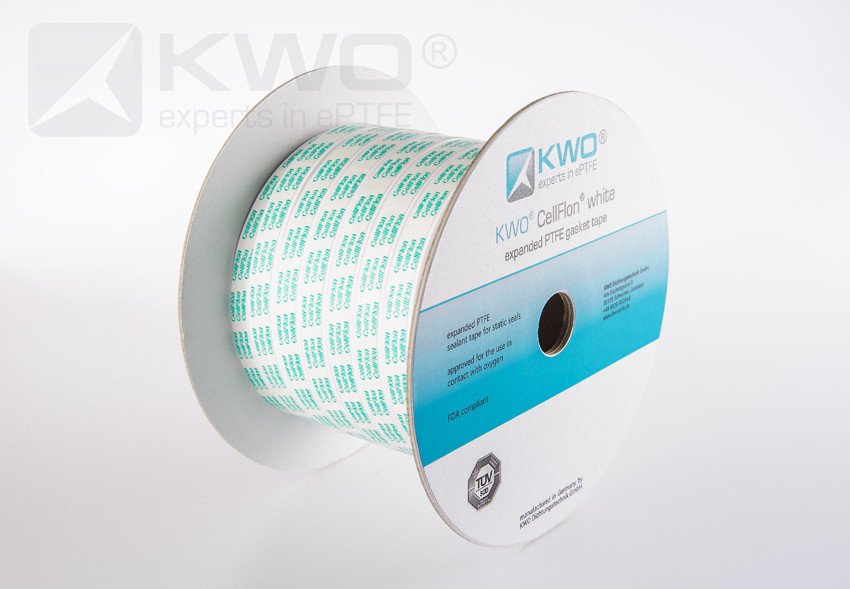
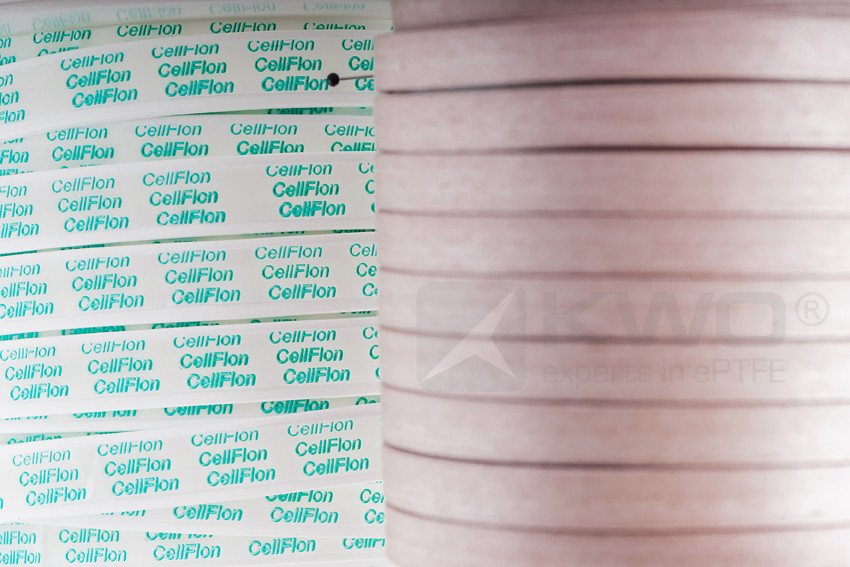
KWO® CellFlon® Tape – ePTFE gasket tape
KWO® CellFlon® Tape is a gasket tape made from expanded virgin PTFE with a modified texture. The gasket tape is particularly suitable for demanding and very clean applications, for example in the food industry and in the pharmaceutical manufacturing sector.
The patented CellFlon® processing method improves considerably the mechanical properties and strengthens the fibre structure. Consequently, the tape is much more compact and has a lower cold-flow tendency as well as better recovery properties.
These characteristics allow a wide range of applications, regardless of the shape and the size of the sealing surface.
Advantages
Attributes
Application
Certifications
Advantages
- high thickness after installation
- low widening
- very good recovery properties
- excellent sealing properties; full resistance
- low diffusion leakage; good tightness performance in an oily environment
- harmless in contact with food
Attributes
- high mechanical properties
- high chemical resistance
- UV resistant; non-ageing
- nontoxic, biologically inert
- non-flammable
Application
- tube flanges, sealings for tanks
- apparatus constructions, machine housing
- chemical reactors
- compensators, pumps
- flue gas plants, food processing systems
Certifications
- TA Luft regulation and blow out safety acc. to VDI 2200
- FDA 21 CFR 177.1550 compliant
- EC1935/2004 – suitable for applications with food contact
- specific values according to DIN EN 13555
| MATERIAL | 100 % expanded PTFE (ePTFE), modified by CellFlon®-procedure - self-adhesive |
| CHEMICAL RESISTANCE | pH range from 0 to 14; full chemical resistance (except molten alkali metals and elemental fluorine) |
| TEMPERATURE RANGE | recommended temperature range: from -200°C (-328°F) to +180°C (+356°F); material heat resistant up to +315°C (+600°F)* |
| PRESSURE RESISTANCE | vacuum up to 80bar (1160psi) depending on the installation situation* |
| PHYSIOLOGICALLY INERT | physiologically harmless in all recommended applications |
| DENSITY | 0,70 g/cm³ ± 0,10 g/cm³ |
*Note: Temperature and pressure guides cannot necessarily be used simultaneously.